Predictive analysis can tell you all the most popular new year’s resolutions.
What it won’t reveal are the human factors that make or break the promises.
Now, as BioFit nears our 80th anniversary, those factors are more important than ever. Our resolve to meet the needs of individuals where they work and how remains the same. Even as many businesses continue to transform under the banner of artificial intelligence, demand for the ‘actual’ variety by workers in labor-intensive roles still has a real place in the workplace.
People who are up to the task are keepers.
So is the seating manufacturer that keeps them on-task.
Serving the needs of the human body first
Predictive large language models might give insights into trending colors and styles, but no algorithm is a match for identifying the features and functions that promote safety while enhancing productivity. That takes authentic human-to-human study of how employees work and what kind of seating can help them work better.
Entering a prompt into a chat engine doesn’t cut it.
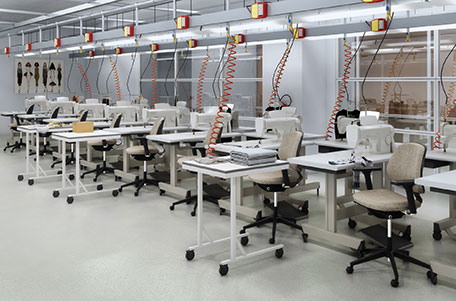
What does is actually talk to front-line employees, their immediate supervisors, and company specifiers in-person. Through that shared dialogue comes breakthroughs in areas like user-control positioning, lumbar support, and backrest height, as well as in characteristics such as seating surface, contour, and slope.
If there’s a cause for concern, it’s not theoretical—it’s practical—learned by listening to feedback from users themselves.
That’s the ground floor for product design and development at BioFit. The ‘must-haves’ include:
- Five-star bases for safety and stability, and simple height-range adjustability;
- Intuitive controls for seat and backrest manipulation;
- Antimicrobial properties and UV inhibitors built-in to the seats and backrests of select models;
- All-welded steel construction and rugged, black powder-coated finishes; and
- Dual-wheel non-marring thermoplastic rubber casters, easy-to-clean tubular steel and cast aluminum bases, and more
Proceeding with an abundance of care
Considering the speed at which so many are moving to embrace AI, there’s a growing sense that traditional innovative thinking—as cultivated through conversational problem-solving and mental labor among design professionals—has been left behind.
Ironic given that today’s AI models train precisely on the product of that labor.
Statistical data about repetitive motion injuries or fatigue-related accidents can tell you what tends to happen in industrial workplaces; yet, it falls far short on insights for developing solutions.
The spoken word—and written ones—by actual people still matter … a lot.
In fact, there’s a healthy give-and-take that happens between us at BioFit and our customers that we never take for granted. Like the old adage of not confusing activity with productivity implies, we are more inclined to take time to reason-through problems than rush-through them.
Doing what it takes for as long as it takes
Along the way toward making the lightbulb, Edison mused he’d found hundreds of ways not to make one!
If not in number, we do admit to having the same tenacity in getting things right. The very real human connection between the work people do and they chairs they sit on isn’t something that can be replicated artificially.
Nor can it be assessed by bots interacting with other bots.
Those results are only illusionary. Only the way employees feel in terms of comfort and wellbeing on the job draws a straight line to the bottom line.
The change really isn’t a change at all. It’s more of a natural evolution from the company you’ve known all along. No new year’s resolutions required!
BioFit thanks you for reading. Please leave a comment or send us a note to learn more.